Wild
A Forest of 47,000 Trees That Is Really One Tree
Pando in Utah is a single clone, joined at the roots. How old it is nobody agrees.
Wild
Yakutian horses live outdoors all winter in one of the coldest inhabited places on Earth. Their ancestors arrived there not very long ago.
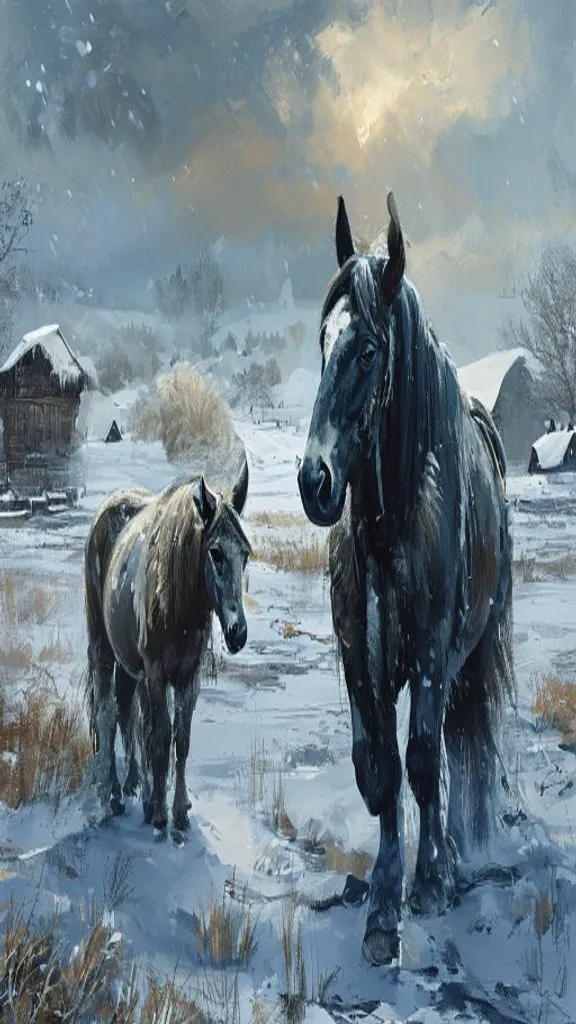
It's fifty degrees below zero, and the horse isn't in a barn. It's out in a field, scraping the snow aside with its hoof to find something to eat.
This is a Yakutian horse, and it lives in Yakutia, also called Sakha, in northeastern Siberia. That's about as cold as a place with people gets. The village of Oymyakon in that region, often called the coldest inhabited place on Earth, has recorded a temperature of around 68 below zero Celsius. The horses stay outside all year, and they don't have a heated stall to go back to.
Short, stocky and short-legged, they look like sturdy ponies. The coat is what you notice. In winter it grows to eight or ten centimeters long, and it has two layers: a dense, soft undercoat that holds in heat, and a longer outer layer that keeps the snow and wet from reaching it. The mane and tail are thick, and the whole animal looks like a haystack with legs.
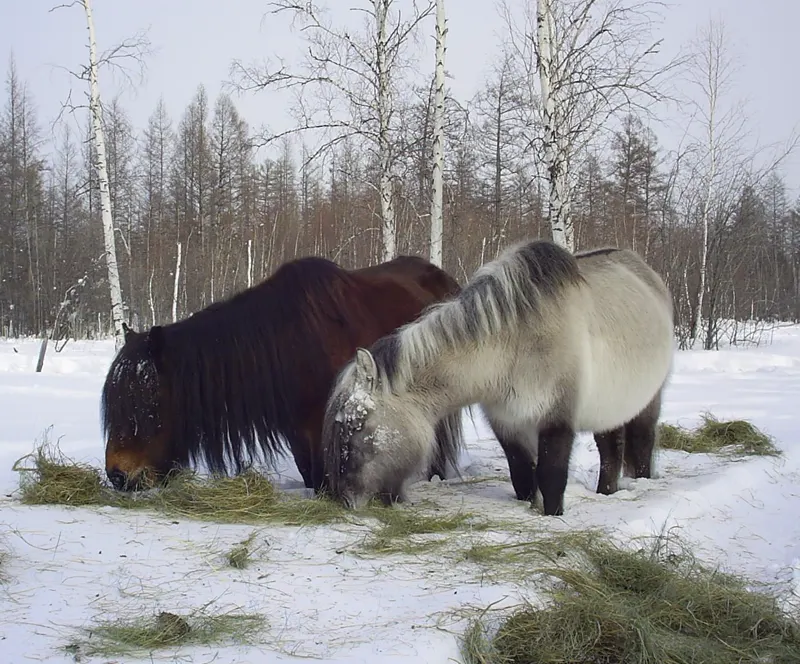
They know how to find food, too. Under the snow there's dry grass left over from summer. The horses sniff it out, even through deep snow, and dig down to it with their hooves. The hooves are tough enough to break a hard crust of ice. They also eat snow when they're thirsty. In the winter they spend most of the day searching for food, and the digging takes a lot of work. This is the hard part: their faces and legs stay exposed to the cold while they do it.
Reports say they also do something that sounds odd. When it's very cold, some of the horses stand still for hours with their heart rate and body temperature dropping, as if in a light sleep, to save energy. People sometimes call it "standing hibernation." Researchers are still studying how that works, and most of what's been written about it is from news reports, not the original studies.
Scientists have also looked at where the horses came from. A study published in 2015 looked at their genes and concluded that the Yakutian horse is a young breed. Its ancestors seem to have arrived in the far north with the Yakut people, the Sakha, around eight hundred years ago, when they moved up from the south. That's not much time. Many of the changes that let them survive the cold, in their coat, their fat and the way they burn energy, seem to have happened in fewer than eight hundred years.
The Sakha people use the horses for meat and for milk. Mares' milk is fermented into a drink called kymys, which people there have enjoyed for centuries.
Eight hundred years is a short time to grow a coat like that.
Wild
Pando in Utah is a single clone, joined at the roots. How old it is nobody agrees.
Wild
The skin is dark. The hairs are see-through. Once, in a zoo, they turned green.
Wild
Researchers in Seattle wore a rubber mask to trap crows. Years later, the crows still scolded it.

Wild
Muktuk is the skin of a whale with a thin layer of blubber. It also carries vitamin C.