Wild
At 50 Below, This Horse Goes Out for Breakfast
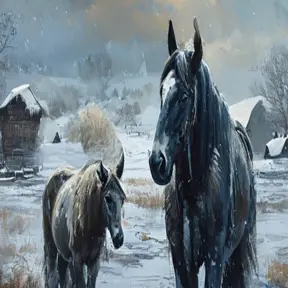
Yakutian horses live outdoors all winter in one of the coldest inhabited places on Earth. Their ancestors arrived there not very long ago.
Wild
Pando in Utah is a single clone, joined at the roots. How old it is nobody agrees.

Is it a forest or one big tree? In Utah, there's a patch of aspen where the answer is both.
It's called Pando, and it grows in Fishlake National Forest, in central Utah. From the road it looks like a normal stand of trees with white trunks and round leaves. But the roots tell a different story. Aspens don't only grow from seeds. They can also send up new shoots from their roots, and each of those shoots grows into a trunk. Every trunk is a copy of the one it came from, with exactly the same genes. Over a very long time, one aspen has sent up shoot after shoot after shoot, spreading underground in every direction. That's what Pando is. It's one living thing, and its name comes from the Latin verb for "to spread."
Scientists checked this by testing the genes of hundreds of the trunks, and they matched. Altogether there are about 47,000 trunks, covering around 43 hectares. That's about sixty football pitches. It's usually described as the heaviest living thing on Earth, at an estimated 6,000 tonnes. Nobody has weighed it, of course. That figure is a calculation, based on counting and measuring stems and guessing at the roots.
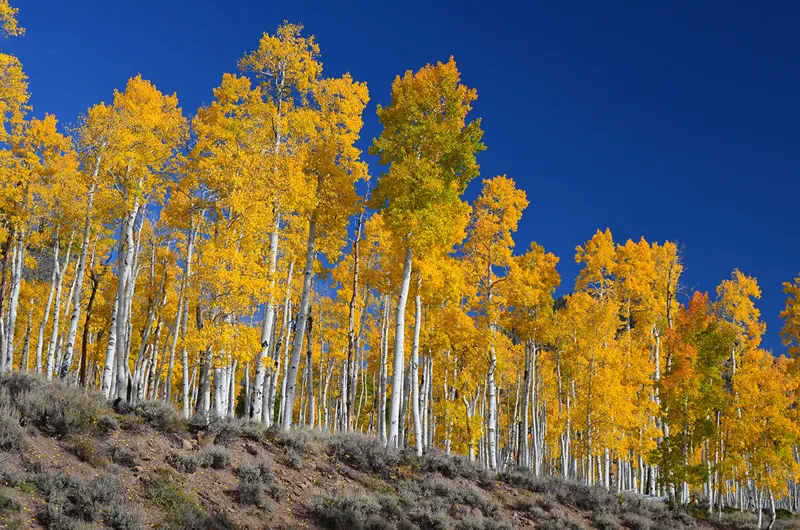
You can tell the trunks are one individual in the fall. When aspen leaves turn yellow, every trunk in Pando turns at the same time and the same shade, as if somebody flipped a switch. In a mixed forest, different trees change on different days. Here they're all the same tree, so they all do it together.
How old is it? It depends on whom you ask. Any single trunk only lives about a hundred years, then dies, and the roots send up another. The roots can last much longer. You may read that Pando is 80,000 years old, but that number isn't well supported. Most estimates say it's thousands of years old, and one model suggested a maximum of about 14,000. Counting rings in a trunk can't tell you, because the trunk is only a hundred years old, and the clone is far older.
There's a problem, though. Young shoots in Pando are getting eaten. Deer and elk like to browse on new aspen sprouts, and in many places the young trees get nibbled before they can grow. Scientists who've studied Pando say that the forest isn't replacing its old stems fast enough. In 2013, a fence went up around part of it to keep the animals out, and the sprouts inside the fence are growing back.
Some people argue that a honey fungus in Oregon is bigger, since it covers much more ground. But Pando is the one that looks like trees, and it has the leaves.
Wild
Yakutian horses live outdoors all winter in one of the coldest inhabited places on Earth. Their ancestors arrived there not very long ago.
Wild
The skin is dark. The hairs are see-through. Once, in a zoo, they turned green.

Wild
Researchers in Seattle wore a rubber mask to trap crows. Years later, the crows still scolded it.

Wild
Muktuk is the skin of a whale with a thin layer of blubber. It also carries vitamin C.