Cities
Those Leaning Houses in Amsterdam Are Mostly Leaning on Purpose
A lot of canal houses tip forward a few centimeters. The builders planned it. The sideways lean is a different story.
Cities
Gustav Vigeland made more than two hundred sculptures for one park, and the city got all of them.

Go looking for the angry boy first.
He's small, he's made of bronze, and he's stamping one foot with his fists clenched, in a park in Oslo. People call him the Angry Boy. In Norwegian he's Sinnataggen. Everybody wants to see him, partly because he's funny and partly because most of the statues around him are a lot more serious.
The park is called Frogner Park, and the sculptures in the main part of it, 212 of them, were all made by one man, a Norwegian called Gustav Vigeland. Some are bronze, some are granite, and some are wrought iron. Nearly every one shows a person, and most of those people aren't wearing any clothes. There are babies, kids, teenagers, couples, old people. They hug, wrestle, carry each other, tumble over, sit by themselves and look sad. If you walked through the whole park you'd see a person at every age doing most of the things a person does.
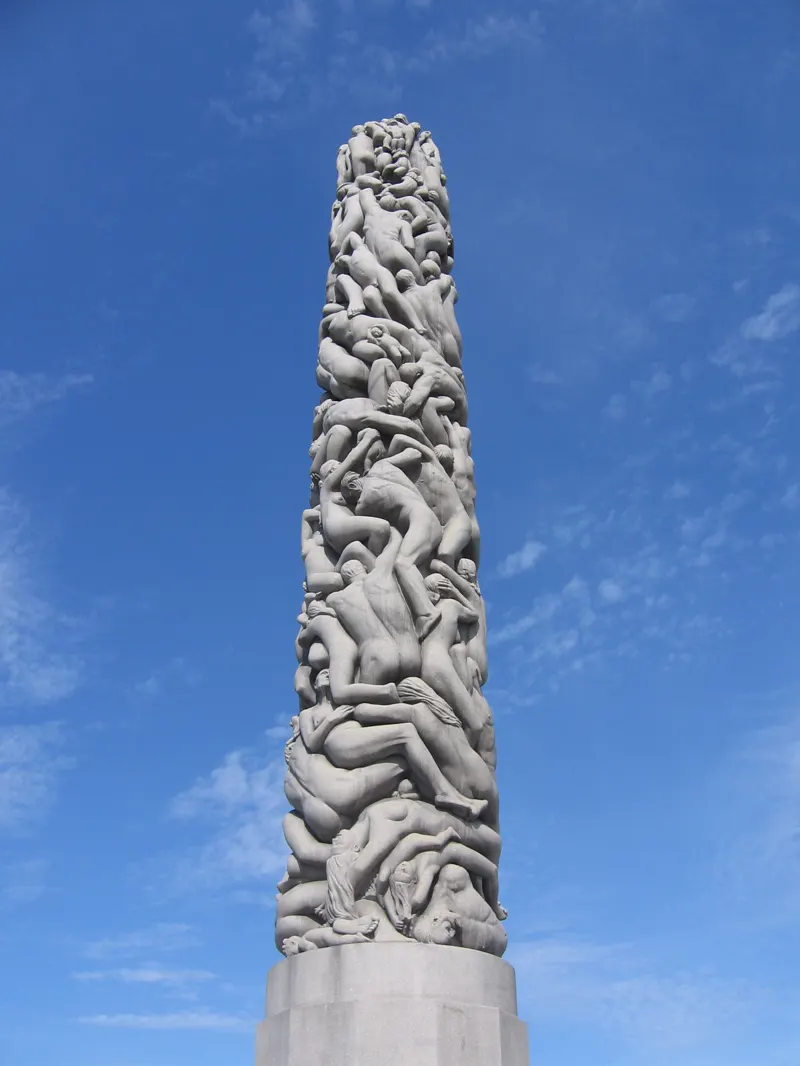
In the middle there's a tall pillar of stone called the Monolith. It's about fourteen meters high, cut from a single piece of granite, and it's covered in 121 human bodies climbing over and on top of one another, all the way up. Vigeland first made it in plaster. Then three stonemasons spent around fourteen years carving the real one out of the rock.
Another sculpture, called the Wheel of Life, is a ring of bodies holding on to each other, like a wreath made of people.
How did one man end up with a whole park? Vigeland lived from 1869 to 1943, and in the 1920s the city of Oslo made a deal with him. The city would give him a big studio and a home. In return, everything he made from then on would belong to the city. He spent the next twenty years or so working on the park, and when he was finished there was nothing left for him to sell, because it had all been spoken for. He didn't only make the statues. He also had a big say in how the whole park was laid out, with a long straight line running from the gate across the bridge and past the fountain up to the Monolith. It's usually described as the biggest sculpture park in the world made by a single artist.
That deal is also why anyone can walk in. You don't have to pay, and you don't need a ticket. It's open all day, and at night too.
The bridge is lined with figures, fifty-eight of them, along both sides, so when you cross it you're walking through a crowd.
And yes, the Angry Boy is on the bridge, in case you were wondering where to start.
Cities
A lot of canal houses tip forward a few centimeters. The builders planned it. The sideways lean is a different story.
Cities
In 2012, librarians moved hundreds of thousands of old manuscripts out of a city that was about to be taken.

Cities
The Vasa was the grandest warship in Sweden. It sailed for less than a mile.

Cities
For decades, getting home in Medellín's Comuna 13 meant climbing the equivalent of a 28-story building. Then the city did something radical — it…