Cities
Those Leaning Houses in Amsterdam Are Mostly Leaning on Purpose
A lot of canal houses tip forward a few centimeters. The builders planned it. The sideways lean is a different story.
Cities
For decades, getting home in Medellín's Comuna 13 meant climbing the equivalent of a 28-story building. Then the city did something radical — it built outdoor escalators up the hillside, and changed the neighborhood's future.
Medellín spreads across the floor of the Aburrá Valley and then, running out of flat ground, begins to climb.
On the city's steep western flank sits Comuna 13 — officially San Javier — a neighborhood of brick-and-cement homes stacked up a gradient so severe that the streets give way to staircases, and the staircases give way to sky.
For most of its history, the only way home was on foot: hundreds of steps rising the equivalent of a twenty-eight-story building, a climb of roughly thirty-five minutes that a woman with groceries or a paramedic with a stretcher simply had to endure. The hill was never neutral. Through the 1980s and '90s it made Comuna 13 both a prize and a trap — a drug-trafficking corridor and a stronghold for guerrillas, gangs, and paramilitaries — and in 2002 it became the target of Operation Orión, a military assault that left the neighborhood with its dead, its disappeared, and a silence that took years to lift. Then, in 2011, the city did something almost absurd in its simplicity.
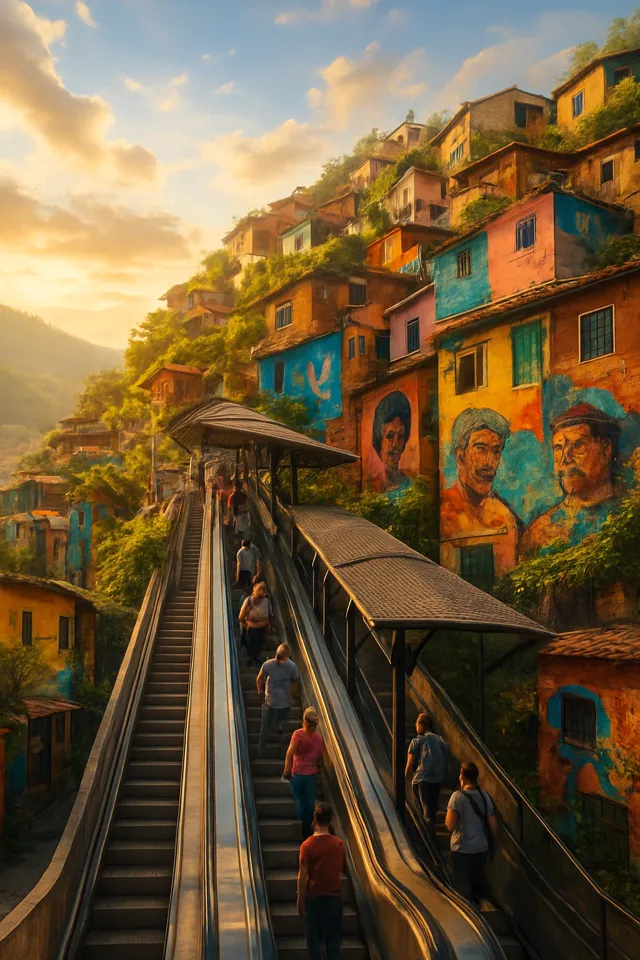
Into that same punishing slope it bolted a series of outdoor escalators — six sections, 384 meters in all, one stairway gliding upward and another easing back down — free to ride, open to the street, and, in the mayor's words, the first project of its kind in the world built specifically for a poor neighborhood.
The thirty-five-minute climb became a six-minute glide. This was not infrastructure as spectacle. It was infrastructure as argument: that a city's most isolated residents are not problems to be contained on a hillside, but neighbors worth reaching.
To understand what the escalators changed, you have to feel the weight of what came before.
Comuna 13 climbs the western wall of the Aburrá Valley at an angle that defeats wheels. The roads serving the lower city simply stop — too steep for buses or cars — and from there the neighborhood ascends on foot.
For its roughly twelve thousand hillside residents, "home" meant hundreds of concrete steps, the vertical equivalent of a twenty-eight-story building, threaded between houses pressed so close that a staircase was often the only street.
The climb took about thirty-five minutes. That number stays abstract until you attach a body to it: an older woman pausing at every landing to let her heart slow, a vendor hauling crates up by the armful, a mother timing the school run against the afternoon rain that turned worn treads slick.
Steepness like this isn't just terrain. It's a tax — paid in minutes, in breath, in the quiet calculation of whether a trip is even worth the climb.
And the same geography that isolated Comuna 13 made it valuable to people who traded in isolation. Its position on the hills turned it into a natural transit corridor — a way in and out of the city above the reach of easy policing — and through the 1980s and '90s it became a contested stronghold for drug traffickers, guerrillas, and paramilitary groups. The slope that exhausted residents gave armed men cover and control.
In 2002 that control was challenged head-on by Operation Orión — a military assault that sent some three thousand troops, backed by helicopters, into the dense hillside warren. It was brutal and remains bitterly disputed: people were killed, wounded, detained, and disappeared, and a fear settled over the comuna that no statistic fully captures.
When the fighting receded, the hill was still there — the same gradient, the same hundreds of steps — now layered with grief. The problem the city faced wasn't only how to move people up a slope. It was how to convince a neighborhood exhausted by both climb and conflict that the rest of Medellín was finally trying to reach it.
The city's answer, when it came, wasn't a road. A road would have meant demolishing homes and carving switchbacks into a slope too steep to hold them.
Instead, in 2011, Medellín installed something you'd normally expect to find inside a shopping mall: a public outdoor escalator, running straight up the hillside.
It's bigger than that sounds. The system climbs in six sections, 384 meters in all (about 1,260 feet), zigzagging up the gradient — one escalator carrying people up, a parallel one easing them back down. It cost roughly $6.7 million and, from the day it opened, was free to use: no turnstiles, no fare, no gate between the neighborhood and the city below.
That choice was the point. Mayor Alonso Salazar called it the first project of its kind in the world built specifically for a poor neighborhood — a claim notable less for the engineering than for the intent behind it.
This was Medellín's "social urbanism" made physical: the deliberate strategy of placing the city's best public infrastructure not in its wealthy center, but in the neighborhoods that had been left to fend for themselves. The escalators followed the same logic as the Metrocable cable cars, opened in 2004 to lift other hillside communities into the transit network. The message was consistent — that a poor address shouldn't mean a hard life.
And the structure didn't hold itself apart from the neighborhood. It was bolted straight into the lived fabric of Comuna 13, threading past front doors and shopfronts, open to the street and the weather (the covered roofs came later). The same walls that once carried bullet scars began to carry murals; the steel and the spray paint rose together.
It was, in the end, a modest machine making an immodest claim: that moving people with dignity is itself a form of justice.
The most immediate change was the one you could measure with a watch. The climb that had taken about thirty-five minutes now took roughly six minutes — a daily half-hour handed back to twelve thousand people, free of charge, every trip up and every trip down.
But the deeper change was harder to clock. Residents describe a neighborhood that slowly exhaled. Children began playing in the streets again. Artists felt safe enough to go outside and paint.
And paint they did. The walls once scarred by years of conflict filled with murals — vivid, defiant, often telling the comuna's own story — until Comuna 13 became one of the most colorful corners of Medellín.
What had been a place people were warned away from became a place people travel to see. Today the escalators and the street art around them draw visitors from across the world: guided graffiti tours, hillside viewpoints, music, ice cream and food stalls where there had once been fear. The neighborhood that headlines called the most dangerous in the world turned into one of the city's signature destinations.
The shift didn't go unnoticed elsewhere. The project became a model for urban planning worldwide, and officials from as far as Rio de Janeiro looked to Medellín, weighing whether something similar might work in their own hillside favelas. The architect, Carlos Escobar, put it plainly: since the escalators were built, he said, "we have never heard anything about violence in this place."
It would be too neat to credit a staircase with all of that. Comuna 13 is still a poor neighborhood, the wounds of Operation Orión are still mourned, and the escalators were only ever one piece of a larger, deliberate effort — cable cars, schools, libraries, parks — to knit the city's hardest hills back into its life.
Tourism brings its own pressures, too: the quiet danger of a living neighborhood being turned into a backdrop.
But ride those steps today, past the murals and the music and the kids who never knew the old climb, and the original argument still holds. Move people with dignity, and a place can begin to move itself.
Antropeo doesn't build escalators. But it's built on the same conviction that runs through this story: that the real world, looked at closely, is stranger and more moving than anything we could invent.
A single fact — Medellín put escalators on a hillside — turns out to hold a whole human geography inside it: a brutal climb, a war, a neighborhood that taught a city how to reach it. That's the thing about places. None of them are only a dot on a map.
This is what Antropeo is for. Every corner of it grows from real, verifiable facts about real places — not trivia to memorize, but doorways into the world as it actually is.
Comuna 13 didn't become remarkable by adopting clever technology. It became remarkable by insisting that progress serve people first — their movement, their dignity, their reclaimed time.
We try to carry the same insistence into how we show you the world: curiosity over cleverness, real stories over abstractions, and the patience to let a single place open all the way up.
So explore one. Pick a dot on the map and follow it inward — and see how far an ordinary fact can take you, step by steady step.
Cities
A lot of canal houses tip forward a few centimeters. The builders planned it. The sideways lean is a different story.
Cities
In 2012, librarians moved hundreds of thousands of old manuscripts out of a city that was about to be taken.
Cities
Gustav Vigeland made more than two hundred sculptures for one park, and the city got all of them.
Cities
The Vasa was the grandest warship in Sweden. It sailed for less than a mile.