Cities
The Books Left Timbuktu in Trunks, at Night
In 2012, librarians moved hundreds of thousands of old manuscripts out of a city that was about to be taken.

Cities
A lot of canal houses tip forward a few centimeters. The builders planned it. The sideways lean is a different story.

Walk along a canal in Amsterdam and you'll see rows of tall, thin houses, and a surprising number of them look as though they're about to tip into the water.
The common explanation is that the ground is soft, the houses are old, and they're sinking. There's some truth in that. But the forward lean you see on many of those houses isn't caused by sinking. The builders did it on purpose.
To see why, look at the top of the front wall of one of those houses. There's usually a beam sticking out, with a hook on the end, and often a pulley. Now look at the stairs. In the 1600s, when many of these houses were built, land along the canals was expensive, and by many accounts the tax was based on how wide your front was. The houses ended up very narrow and very tall. The staircase inside was steep and tight, so tight that a sofa, a table or a big chest couldn't be carried up.
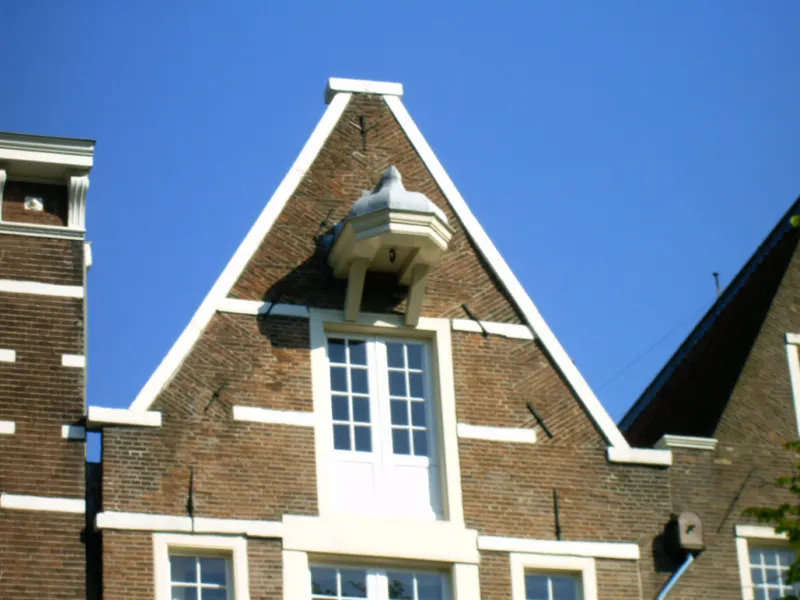
So people did what you'd do. They hung a rope from the hook, tied the furniture to it, and hoisted it up the outside of the house to a window. But if a house stood straight, the furniture would swing and scrape along the front wall, and might break a window. If the front leans forward by a small amount, the goods hang clear of the wall all the way up. That's why many houses were built tilting forward. The tilt is small, a few centimeters over the whole height, but you can see it from across the canal.
Houses lean sideways too, and that's not on purpose. That's the soft ground. Amsterdam was built on wet peat and clay, and nothing heavy will stay up there without help. So builders drove long wooden poles, called piles, down through the mud until they hit a firmer layer of sand. The houses sit on those. The Royal Palace in the heart of the city, for instance, is said to stand on more than thirteen thousand of them.
Wood lasts a long time under water, as long as water covers it. If the water level drops and air gets in, the piles can start to rot. Over the centuries some houses have sunk unevenly, and a few have been propped up with iron braces. There's a stretch along the Amstel River called the Dancing Houses, where the buildings lean at all kinds of angles, like people who've had a bit too much to drink.
So the next time you walk past a tilted house in Amsterdam, you can tell which way it's leaning. Forward means the builder did it, and sideways means the ground did.
Cities
In 2012, librarians moved hundreds of thousands of old manuscripts out of a city that was about to be taken.
Cities
Gustav Vigeland made more than two hundred sculptures for one park, and the city got all of them.

Cities
The Vasa was the grandest warship in Sweden. It sailed for less than a mile.

Cities
For decades, getting home in Medellín's Comuna 13 meant climbing the equivalent of a 28-story building. Then the city did something radical — it…