Cultures
The Silk Road Wasn't a Road, and Nobody Called It That
Traders carried goods across Asia in short legs. The name only appeared in 1877.

Cultures
The Olmec carved heads from basalt boulders carried across the jungle. Each face looks like a particular person.

Look at them side by side and you'll see that nobody told these sculptors to make one head and copy it.
There are seventeen of the giant stone heads known today, and each one is different. One has a broad, flat nose and a frown. Another has a face that's rounder and softer. They all wear caps, like helmets, but the patterns on each one are different too. It's very likely that each head shows a real person, probably a ruler. That's why most scholars think of them as portraits.
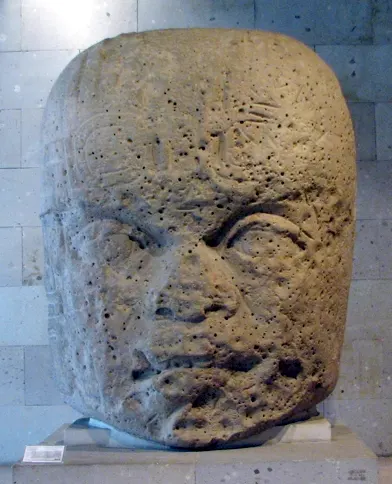
They were made by the Olmec, who lived along the Gulf Coast of Mexico about three thousand years ago, between roughly 1200 and 400 BCE, in hot, wet land with rivers and swamps. They carved the heads from basalt, a hard volcanic rock, and the biggest ones are around three meters tall and weigh dozens of tons. The smallest known head is about a meter and a half tall.
The puzzle is the stone. The basalt doesn't come from where the heads were found. It comes from the Tuxtla Mountains, a volcanic range some distance away. Estimates of how far differ, from about sixty to well over a hundred kilometers. And the Olmec didn't have wheeled carts or big animals like oxen or horses to pull loads. Somehow, they got stones as heavy as a truck across rivers and through jungle. People have suggested rafts for the water and wooden rollers or sledges for the land, but nobody knows for sure, since nobody wrote it down.
Several of the heads weren't carved from fresh boulders at all. Some began as another kind of monument, a big stone throne, and were later recut into a face. Some scholars think the stone was reused when a ruler died or lost power.
The heads are found at four main sites: San Lorenzo, La Venta, Tres Zapotes and a small one called Rancho La Cobata. The first one was found in the 1860s, when a farmer clearing a field in the state of Veracruz hit something solid. Digging it out, he found a giant stone face looking back at him. For many years, outside Mexico, hardly anyone knew about it.
These days the heads sit in museums and parks in Mexico, some in the open air in the villages near where they were found. They're the best-known thing the Olmec left, and they're also the reason people argue about who the Olmec were.
And "Olmec" is not even what they called themselves. That's a name the Aztecs gave to people who lived in that region, hundreds of years later, and it means "rubber people," because of the rubber trees. Nobody knows what the Olmec called themselves.
Cultures
Traders carried goods across Asia in short legs. The name only appeared in 1877.
Cultures
Shinrin-yoku is a Japanese idea: walk slowly among trees, on purpose, and notice things.

Cultures
In 1932 the Australian army went out to deal with emus. The emus were still there when the soldiers left.

Cultures
Lapis lazuli traveled thousands of kilometers to reach Egypt, then Italy, and ended up in a lot of famous paintings.