Cultures
Seventeen Giant Stone Faces, and No Two Are the Same
The Olmec carved heads from basalt boulders carried across the jungle. Each face looks like a particular person.

Cultures
Shinrin-yoku is a Japanese idea: walk slowly among trees, on purpose, and notice things.

No bath. No water. No soap. Nobody takes their clothes off.
Forest bathing is just walking slowly in a forest, on purpose, and paying attention to where you are.
The Japanese name is shinrin-yoku. Shinrin means forest, and yoku means bath, as in soaking something up. The phrase was invented in 1982 by Japan's forestry agency, as a catchy way to get people to spend more time in the woods. It was a good guess at what people needed. About two-thirds of Japan is covered in forest, and a lot of Japanese people live and work in very crowded cities.
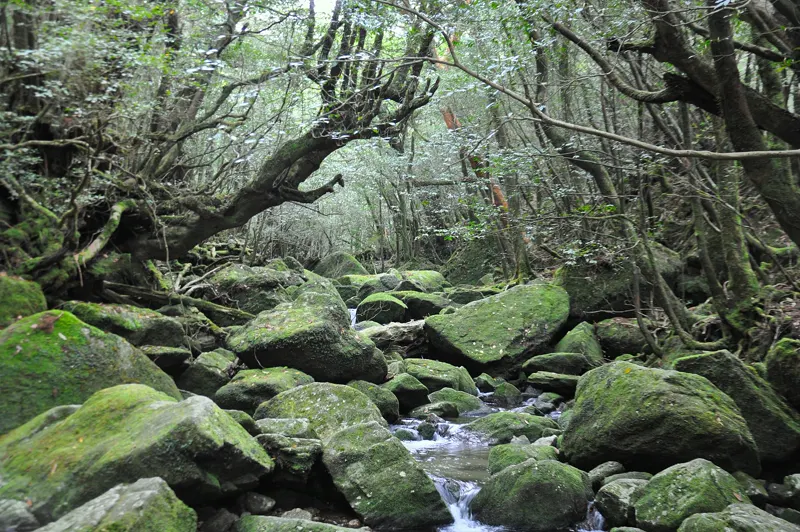
So what do you actually do?
It isn't a hike. There's no goal and no summit, and nobody's counting steps or checking the time. Guides who lead these walks often cover only a kilometer or two in a couple of hours. You walk slowly, and then you stop. You smell the air. You put your hand on the bark of a tree and notice how rough it is. You listen to what's making a noise, and then to what's making a noise behind that. You look up at the light coming down through the leaves, which Japanese has a word for: komorebi.
Is there any science in it? Some. Researchers in Japan, and in other countries since, have measured people before and after walks in a forest and walks in a city. In a number of studies, the forest walkers had lower levels of cortisol, a hormone linked to stress, and slightly lower blood pressure and heart rate. That's not true of every study, and the effects are often small, so nobody can say it works like medicine. But the pattern shows up often enough that Japan has set up official forest therapy trails, dozens of them, with trained guides.
There's also a more unusual idea. Trees give off chemicals into the air, and some researchers have wondered whether breathing those in might be part of why people feel better. That one is much less certain. Scientists are still testing it, and it hasn't been settled.
What seems clearer is the simplest part. If you take away the phone, the schedule and the talking, and just stay among trees for a while, a lot of people feel calmer afterward. The idea has since spread well beyond Japan, where it's called forest bathing or forest therapy, and you don't need a special forest to try it. You don't need to travel anywhere, either. A park with a few old trees will do.
To try it, next time you're in a park or on a street with a tree, stand near it for two minutes. Don't talk, and leave your phone in your pocket. Count how many different sounds you can hear without moving your head.
Cultures
The Olmec carved heads from basalt boulders carried across the jungle. Each face looks like a particular person.
Cultures
Traders carried goods across Asia in short legs. The name only appeared in 1877.

Cultures
In 1932 the Australian army went out to deal with emus. The emus were still there when the soldiers left.

Cultures
Lapis lazuli traveled thousands of kilometers to reach Egypt, then Italy, and ended up in a lot of famous paintings.