Cultures
Seventeen Giant Stone Faces, and No Two Are the Same
The Olmec carved heads from basalt boulders carried across the jungle. Each face looks like a particular person.

Cultures
Copernicus gets the credit. Aristarchus of Samos had the idea first, and a good reason for it.
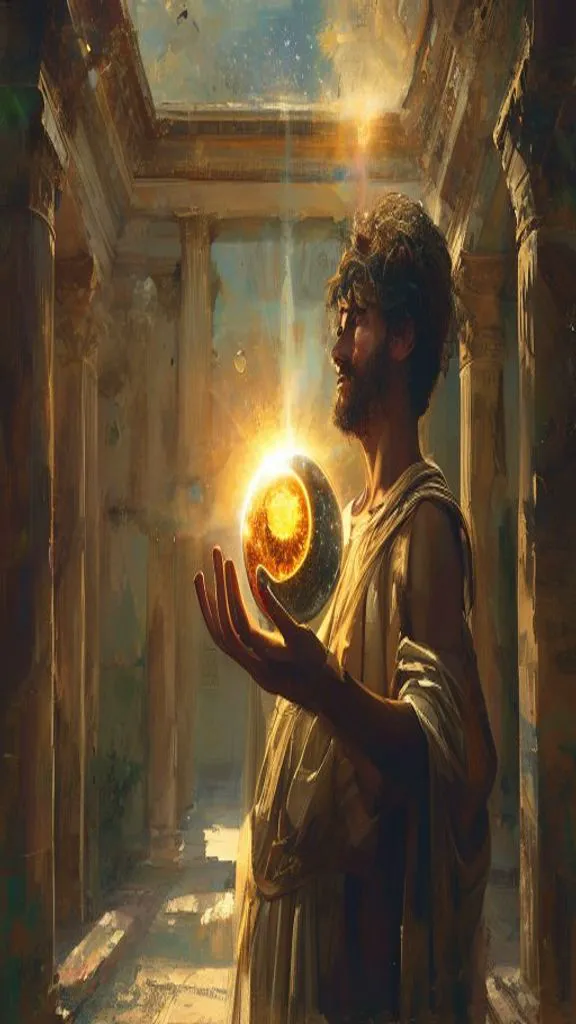
In 1543, a Polish astronomer called Nicolaus Copernicus published a book saying the Earth goes around the Sun. People still talk about it as one of the biggest turning points in the history of science. Fair enough. But he wasn't the first to say it. Not even close. A Greek man had said it about eighteen hundred years earlier.
His name was Aristarchus. He lived on the island of Samos in the third century BCE, and almost everything he wrote has been lost. We know about his Sun-in-the-middle idea mostly because another Greek, Archimedes, mentioned it in a book of his own and politely disagreed with part of it.
The one book of Aristarchus that does survive isn't about the Sun in the middle at all. It's about how big the Sun and Moon are, and how far away.
His method was neat. When the Moon looks exactly half lit, the Sun, the Moon and the Earth make a triangle with a right angle at the Moon. If you can measure the angle at the Earth, then geometry tells you how much farther away the Sun is than the Moon. Aristarchus measured the angle and got about 87 degrees. The real angle is about 89.85. That tiny difference is why he decided the Sun was roughly twenty times farther away than the Moon, when it's really about four hundred times.
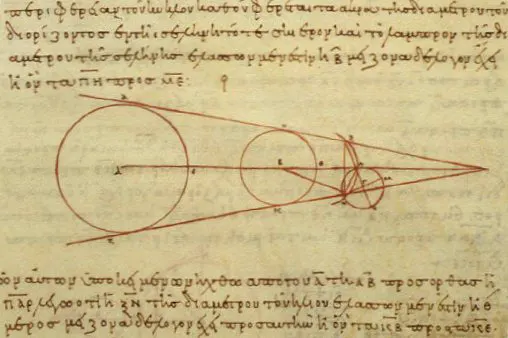
The idea was right. The measurement was too delicate to do well without proper instruments. He also guessed that the Moon is about a third as wide as the Earth, when it's a little over a quarter, which isn't bad for a man working with geometry and his eyes. And he still worked out that the Sun had to be far bigger than the Earth. That's usually given as his reason for putting the Sun at the center: a big thing going around a small thing seemed odd to him.
Plenty of people didn't buy it. One problem was that if the Earth moves around the Sun, the stars ought to seem to shift a little over the year, the way a tree seems to slide against the hills behind it when you walk past. Nobody could see any shift. According to Archimedes, Aristarchus answered that the stars must simply be extremely far away.
He was right about that too. The shift is real. It's so small that nobody measured it until 1838, when a German astronomer named Friedrich Bessel managed it for a star called 61 Cygni.
Put the dates side by side. A good idea around 270 BCE. Copernicus bringing it back in 1543. And the first proof that the stars are really that far away in 1838, more than two thousand years after Aristarchus first guessed it.
Cultures
The Olmec carved heads from basalt boulders carried across the jungle. Each face looks like a particular person.
Cultures
Traders carried goods across Asia in short legs. The name only appeared in 1877.

Cultures
Shinrin-yoku is a Japanese idea: walk slowly among trees, on purpose, and notice things.

Cultures
In 1932 the Australian army went out to deal with emus. The emus were still there when the soldiers left.