Earth
Who Found Machu Picchu? A Farmer Walked Him There
In 1911 an American professor was led up the mountain by a local man. The families who lived there already knew the place.

Earth
Two spacecraft carry a gold-plated record with Earth's sounds, and Voyager 1 is about to be a full light-day away.
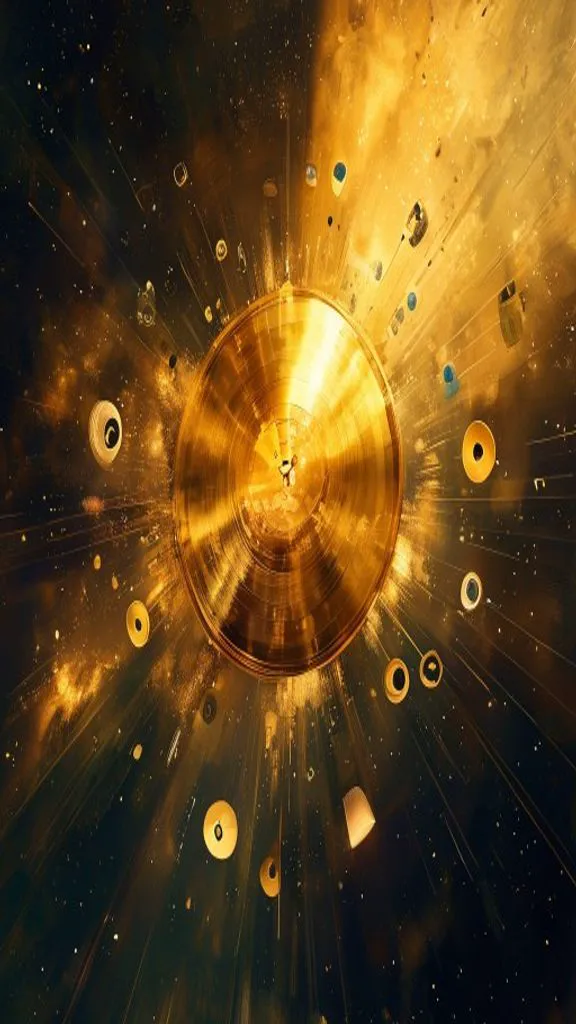
Out beyond the planets, there are two record players with the needle already attached.
Okay, not really. But close. Two NASA spacecraft, Voyager 1 and Voyager 2, were launched in 1977, and each one carries a gold-plated copper disc about the size of a big dinner plate. It's a record, the kind you play with a needle. A cartridge and a needle came with it, and the cover is covered in drawings that show how to play it.
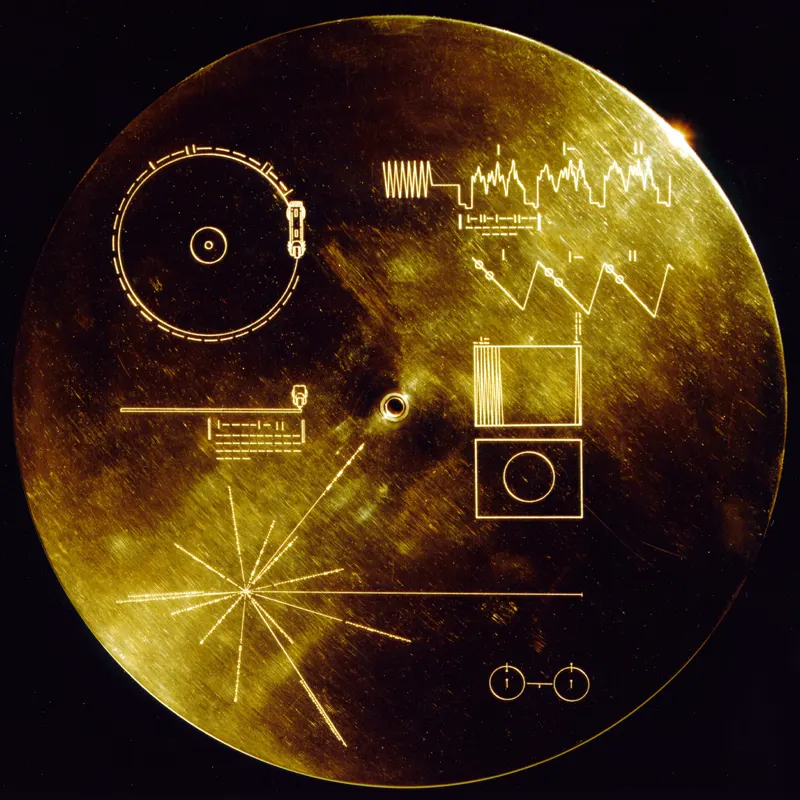
The idea was that someday, somebody who isn't from Earth might find one. A small group led by the astronomer Carl Sagan decided what to put on it. On the record there are 115 pictures, from a baby being born to a picture of a supermarket. There are greetings in 55 languages. There's a mix of sounds: rain, wind, thunder, a train, a dog barking, laughter, a kiss, a mother talking to her baby, and the songs of whales. And there's music, about ninety minutes of it, from Bach and Beethoven, Louis Armstrong, Chuck Berry's "Johnny B. Goode", and songs from all over the world.
The cover has a map too. It shows where we live, using the positions of fourteen pulsars, which are stars that flash on and off at a steady rate, like clocks in the sky. If you can read the clocks, you can work out where on the map Earth is.
Gold-plated copper is tough. People who study these things say the record could last a billion years. But the chance that anyone ever finds it is very small, since the spacecraft are headed for empty space, not toward any particular star. The record is more like a message in a bottle: you throw it in, and you don't expect an answer.
Both craft are still sending signals, but they're getting old. In 2012 Voyager 1 went through the edge of the bubble of particles that streams out from the Sun, and it was the first human-made object to reach interstellar space. You'll sometimes hear that it left the solar system. That's not quite right. The solar system also includes a vast cloud of icy bodies, and Voyager won't get there for tens of thousands of years.
Voyager 1 also looked back once. In 1990 it turned its camera around and took a picture of Earth from about six billion kilometers away. The planet is a tiny, pale dot in a streak of sunlight, and people call the photo the Pale Blue Dot.
It's now so far away that a radio message takes close to a day to reach it. NASA says it will reach one light-day from Earth on November 18, 2026. That works out to about 26 billion kilometers.
One of the greetings is in English, spoken by a boy: "Hello from the children of planet Earth."
Earth
In 1911 an American professor was led up the mountain by a local man. The families who lived there already knew the place.
Earth
In 1883 a volcano in Indonesia blew up. The bang crossed the Indian Ocean, and the pressure wave went around the world.
Earth
A Maya pyramid in Mexico seems to hold a snake made of shadow and a bird made of echoes. Nobody knows whether that was planned.
Earth
In 1991 a man in Vietnam found a cave by its sound. It has its own river, its own weather and its own jungle.