Wild
At 50 Below, This Horse Goes Out for Breakfast
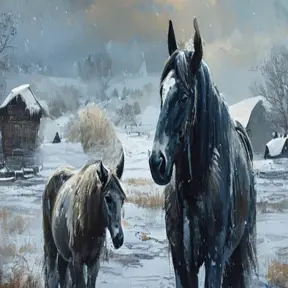
Yakutian horses live outdoors all winter in one of the coldest inhabited places on Earth. Their ancestors arrived there not very long ago.
Wild
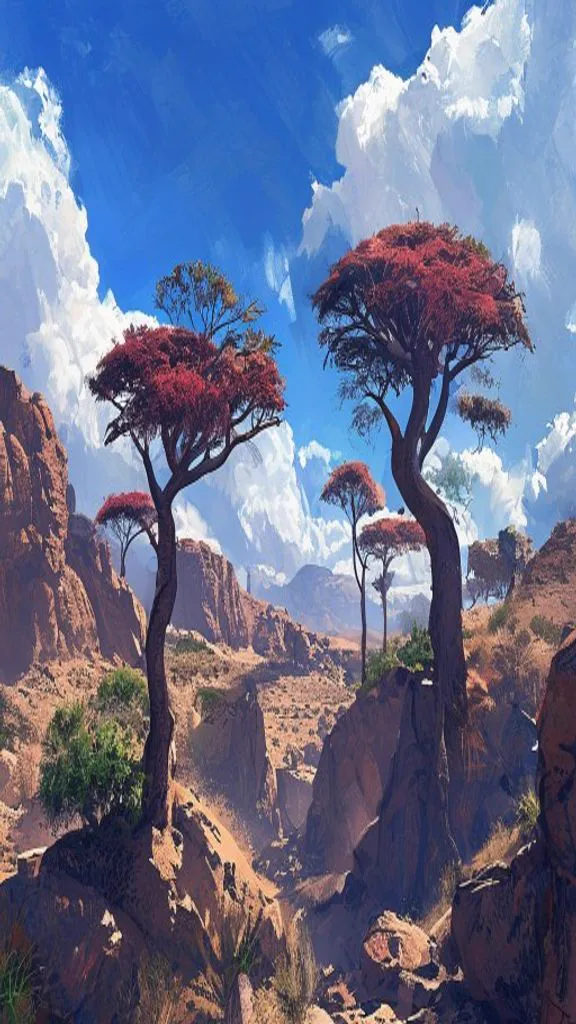
At dawn on a limestone plateau 240 km off the Horn of Africa, dragon blood trees stand like upturned umbrellas, bleeding a red resin traded since antiquity — on an island where a third of all plant life exists nowhere else.
At first light on Socotra's high plateau, the air is cool and thin and smells faintly of resin, like crushed pine left in the sun.
The dragon blood trees rise out of the limestone as silhouettes — thick, bottle-shaped trunks wedged into fissures in the pale rock, flaring without warning into dense, flat-topped crowns that look less like canopies than umbrellas blown inside out and frozen there.
They are not built for any world you know. Cut the bark and they bleed: a deep red sap that beads, hardens to a brittle glaze, and has been scraped, traded, and ground into medicine since antiquity — the Soqotri call it dum al-akhawain, "blood of the two brothers." Socotra is not remote because the world forgot it. It is remote because roughly 240 kilometres of sea, and some twenty million years of isolation, let it become stubbornly itself — an island where a third of the plant life grows nowhere else on Earth, and where evolution took turns no mainland ever attempted.
The dragon blood tree (Dracaena cinnabari) doesn't grow tall to win light. It grows wide to drink fog. From June to September the monsoon drives cloud off the Arabian Sea onto Socotra's uplifted ridges, and the trees' broad, tight-packed crowns are thought to comb moisture straight out of the passing mist, funnelling it down the trunk to roots spread through thin soil.
The leaves do their part — stiff, waxy, sword-shaped, bunched in rosettes at the branch tips — cutting water loss to the drying wind while offering the most surface for droplets to bead and run.
Even the way it grows is unusual. Most plants of its lineage, the monocots, don't thicken with age; Dracaena does, laying down zones that read almost like the rings of an oak, so that the girth of a trunk becomes a rough ledger of the decades it has stood here.
The resin made the tree matter to people long before botanists came to measure it.
Bright red, sticky, quick to set hard, dragon's blood has served for centuries as dye, varnish, incense, and folk medicine across Socotra and the wider Indian Ocean world.
The trade is old enough to have left its mark on the record and perhaps on the island's own name: a first-century Greek merchant's manual, the Periplus of the Erythraean Sea, lists the red "cinnabar" among local cargoes, the physician Dioscorides wrote of the resin a generation later, and by one reading the word "Socotra" itself descends from a phrase meaning the market of dragon's-blood drops. None of this was ever industrial. The trees grow slowly and live for centuries, and what endured alongside them was a careful relationship — shallow cuts, modest harvests, the plain understanding that a tree pushed too hard gives less. It was knowledge kept by watching rather than writing, because the trees stood here long before anyone needed paper to remember them.
Socotra sits about 240 kilometres east of the Horn of Africa and some 380 kilometres south of mainland Yemen — close enough to Somalia to be mistaken for it, far enough from everything to have drifted out of the continental gene pool for around twenty million years.
Its bones are mixed. Much of the island is uplifted seabed — pale Cretaceous limestone and dolomite, laid down beneath a shallow sea, then heaved up and carved into plateaus, gorges, and salt-bitten cliffs. At its core, though, stand the Haggier Mountains, far older granite that rakes the monsoon cloud and wrings it dry.
That contrast runs the place: porous limestone drinks the little rain that falls and stores it underground, feeding springs that carry date palms, figs, and hill villages through the dry season, while the high granite ridges catch the mist the parched lowlands never see.
Cut off that long, the island turned into a workshop for the singular. The dragon blood tree is only its emblem; the supporting cast is just as strange. Frankincense and myrrh trees cling to the rock.
The desert rose swells into a grey, bloated bottle of a trunk, then bursts into pink flower at its tip. The cucumber tree — the only member of the cucumber family that grows as a tree at all — stands fat and pale on the plains like something half-finished. The numbers behind the spectacle are stark: of Socotra's roughly 825 plant species, more than a third live nowhere else, and the same isolation has pushed about 90 percent of its reptiles and 95 percent of its land snails into endemic forms found only here.
This is what time does to a marooned scrap of land — it stops importing answers and starts inventing its own.
The best place to feel the tree's predicament is a limestone shelf in the interior called Rokeb di Firmihin — a few hundred hectares of dense dragon blood forest that now shelters a large share of all the mature trees left.
Walk it and the trouble shows in the age of the wood: ancient, broad-crowned giants spaced across the rock, and beneath them almost nothing coming up.
A forest with no childhood is a forest on a clock. The pressures stack. Drought widens the gaps between good years.
Cyclones — rare but ruinous — can flatten in a night what took centuries to grow; in November 2015 two of them, Chapala and Megh, struck within a single week, a back-to-back pairing with no precedent in the island's records, drowning wadis and stripping groves. And the goats finish what the storms start, introduced long ago and now everywhere, browsing each new seedling to the ground before it can root.
What's being done is unglamorous and slow, which is the only kind of thing that holds here.
Conservation leans on fenced enclosures and small community nurseries: seedlings raised from local seed, walled off from grazing long enough to gain a head start, then planted out on the high, fog-washed ground the old trees chose for themselves.
It depends as much on local reading of the land — which slopes keep moisture, where the cloud settles — as on any map. The tree itself stays indifferent to the words we hang on it: "endemic," "endangered," "heritage." It grows where conditions allow, sheds its leaves when the air dries, and bleeds red when cut — not as spectacle, but as plain physiology. Its endurance was never mystical. It is slow, chemical, and conditional, and it asks only one thing back: that someone keep watching long enough to notice.
At Antropeo we're less interested in places that look strange than in places that explain something — where a landscape, given enough time and isolation, becomes an argument about how life adapts.
Socotra is one long version of that argument: a tree shaped by fog, an island shaped by sea, a people shaped by both. It's the kind of geography that doesn't fit on a flashcard — and that's exactly the point. That's the world Antropeo is built to make legible: not capitals to memorise, but places worth slowing down for, one fact at a time.
Socotra is one of more than two thousand of them waiting in the game — start with the dragon blood tree, and see how far the map pulls you.
Wild
Yakutian horses live outdoors all winter in one of the coldest inhabited places on Earth. Their ancestors arrived there not very long ago.
Wild
Pando in Utah is a single clone, joined at the roots. How old it is nobody agrees.
Wild
The skin is dark. The hairs are see-through. Once, in a zoo, they turned green.
Wild
Researchers in Seattle wore a rubber mask to trap crows. Years later, the crows still scolded it.