Hverfjall: A 2,500-Year-Old Fossil Explosion — The Phreatomagmatic Birth of Iceland’s Perfect Circle
Hverfjall, a 2,500-year-old phreatomagmatic tephra ring in Iceland’s Mývatn region, remains one of Earth’s most geometrically perfect volcanic landforms—and one of its quietest. This is how groundwater, magma, and time forged a crater that resists both erosion and life.
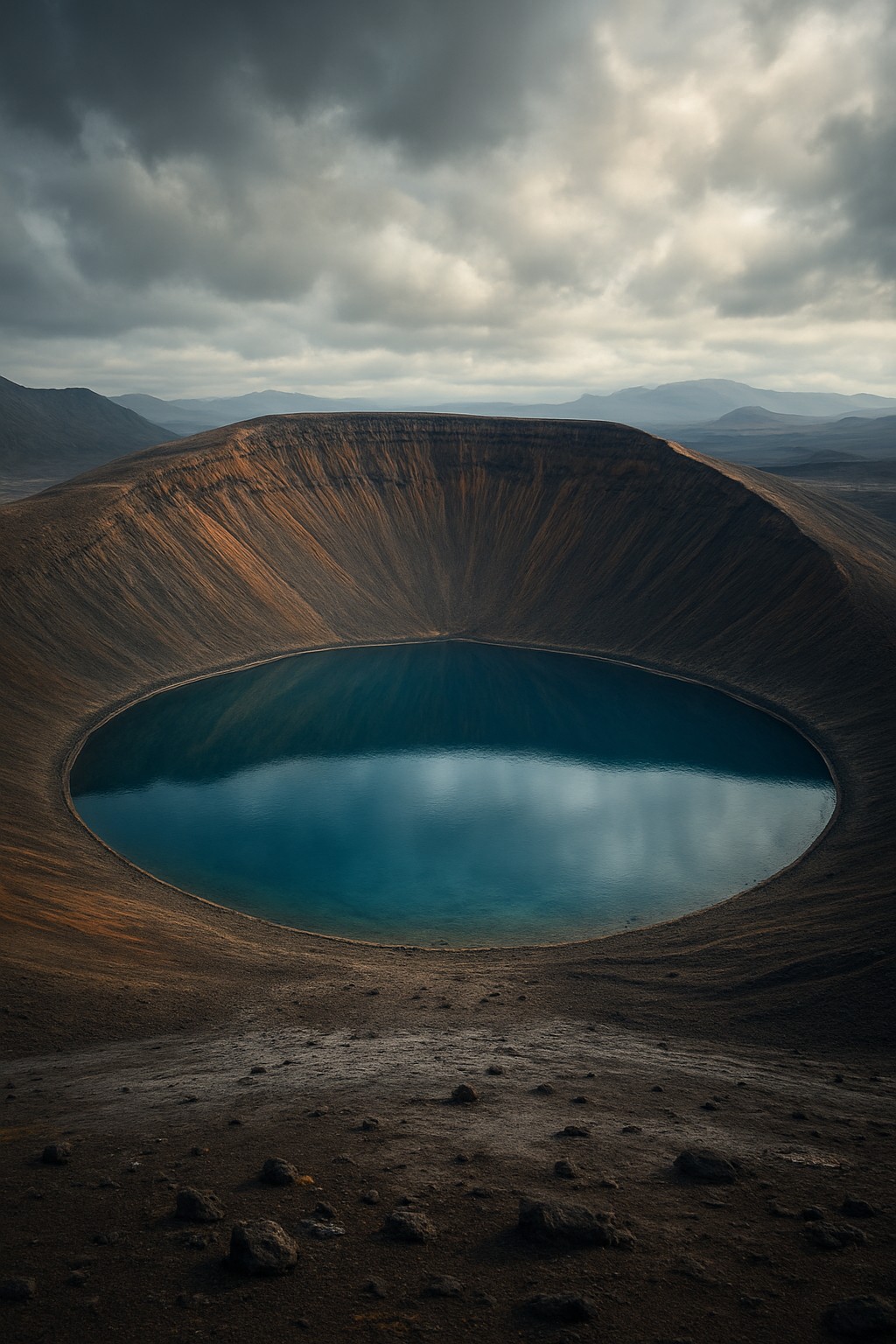
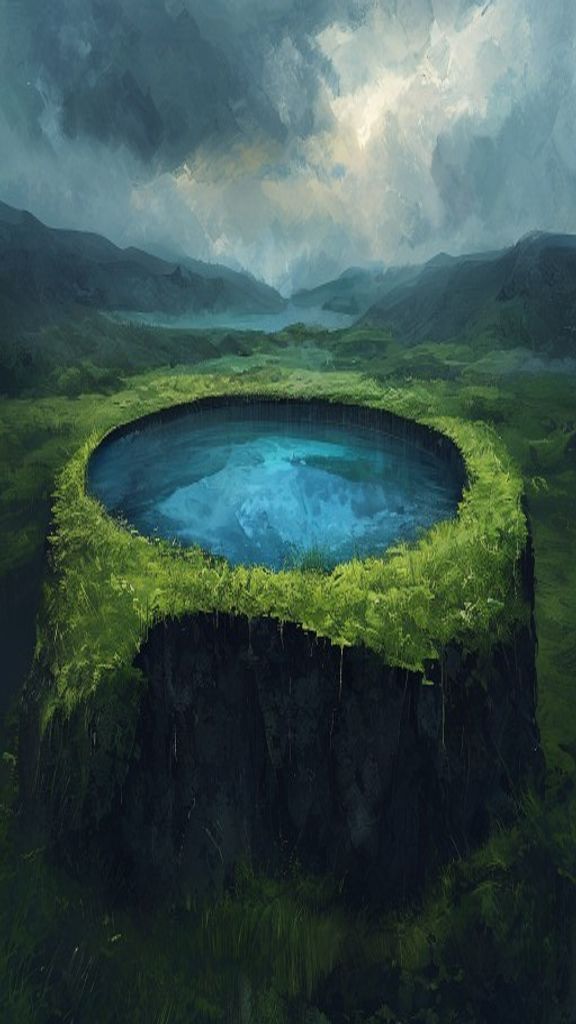
The first thing that strikes you isn’t the scale—it’s the silence. Standing on the rim of Hverfjall, a wind-scoured lip of black ash and rust-red scoria, you hear only your own breath and the low hiss of air moving across thousands of tonnes of pulverised basalt. Below, the crater floor is a flat, pale disc, like a dried lakebed dusted with snow—except it’s not snow, but fine tephra, still uncolonised by moss or grass after two and a half millennia. No trees grow here. No streams cut through. Just a near-perfect circle, 1 kilometre wide, 140 metres deep, carved not by ice or water, but by an explosion so violent it tore apart the earth where groundwater met rising magma. This isn’t a scar left by slow erosion or ancient lava flows. It’s a fossilised instant: the moment Iceland’s crust exhaled steam, ash, and fury in one sustained, roaring pulse. Geologists call it a tephra ring—a rare, textbook example of a phreatomagmatic eruption, where magma didn’t just rise and spill, but collided catastrophically with shallow aquifers. The result wasn’t a mountain, but a void shaped with eerie precision. And yet, for all its scientific clarity, Hverfjall feels less like a geological exhibit and more like a threshold—quiet, elemental, and strangely intimate.
How Water and Fire Made a Circle
Phreatomagmatic eruptions are not the most common kind—but they are among the most explosive. Unlike effusive basaltic flows that ooze from fissures across Iceland’s rift zones, or even the more familiar Plinian eruptions that build towering ash columns, phreatomagmatic events happen when red-hot magma—often at 1,000°C or more—meets groundwater, snowmelt, or shallow lakes. The contact is instantaneous and catastrophic. Water flashes to steam in milliseconds, expanding up to 1,700 times its original volume. That expansion doesn’t just lift ash; it shatters the surrounding rock, fragments the magma itself, and blasts everything upward in a turbulent, wet, particle-laden jet. At Hverfjall, this process repeated over hours or possibly days, each blast ejecting fine ash, lapilli, and dense scoria that fell back around the vent in symmetrical arcs. Because the water source was likely shallow and evenly distributed beneath the surface—and because the underlying bedrock was relatively uniform—the eruption maintained remarkable radial symmetry. There’s no dominant vent offset, no lopsided accumulation. Just a clean, unbroken ring. Field studies confirm the tephra layers dip outward at consistent angles—35 to 40 degrees—like the slope of a freshly dug moat. What’s more, the composition tells a story of mixing: glassy shards of quenched magma interlayered with lithic fragments of older volcanic rock, all bound together by fine ash that settled like sifted flour. No lava flows breached the rim. No secondary cones formed inside. The energy was spent entirely in vertical ejection and lateral fallout. That’s why, today, you can walk the full circumference without encountering a single breach or slump—just wind-polished slopes, occasional frost cracks in the ash, and the faint, sulphurous tang of residual geothermal seepage near the base, a quiet echo of the heat that still lingers below.
A Landscape That Refuses to Heal
Most volcanic landforms in Iceland evolve quickly. Lava fields cool, crack, and host pioneer mosses within decades. Glaciers retreat, exposing raw till that greens within a century. But Hverfjall remains stubbornly bare—its inner floor almost unnervingly smooth, its slopes still loose underfoot, shedding small cascades of ash with every gust. This isn’t neglect by nature. It’s resistance. The tephra here is exceptionally fine-grained and chemically unstable—rich in volcanic glass that breaks down slowly, lacks organic binding agents, and holds almost no moisture. Rainwater percolates straight through; wind lifts particles easily. Without roots to anchor it, the surface stays mobile. Botanists have documented only three vascular plant species reliably establishing within the crater: dwarf willow, Arctic thyme, and a hardy sedge—all clinging to micro-depressions near the outer base, where wind-blown soil and organic debris accumulate. Inside the ring? Almost nothing. Lichens appear as grey smudges on larger scoria clasts, but true soil formation has barely begun. Even the famous Icelandic mosses—those velvety carpets that soften lava fields elsewhere—struggle here. Their rhizoids need stable substrate, not shifting ash. This arrested development makes Hverfjall a rare open-air laboratory. Scientists return year after year not to watch change, but to measure stasis—to track how long it takes for life to gain purchase on pure fragmentation. In one long-term plot study, researchers buried ceramic tiles at varying depths and orientations to monitor microbial colonisation. After ten years, biofilm appeared only on the north-facing, shaded undersides—suggesting even microbial life waits for shelter before committing. The crater doesn’t feel barren in a desolate way. It feels suspended—like a pause button pressed mid-process, holding time in place while the rest of the island surges forward with glaciers calving, rivers cutting new channels, and birch forests creeping uphill.
Walking the Rim, Reading the Ring
There are no marked trails into Hverfjall—not because access is restricted, but because none are needed. The slope is gentle enough to walk, steep enough to demand attention. Most visitors descend along the northwestern flank, where the ash is slightly coarser, offering better grip. Halfway down, the texture changes: the fine powder gives way to fist-sized scoria bombs, some still retaining their aerodynamic spin marks—evidence they were hurled spinning from the vent, cooling mid-air. Near the base, the ground softens again, and your boots sink slightly with each step, releasing a dry, mineral scent—like crushed flint and cold iron. From the rim, the view stretches eastward across the Mývatn basin: a mosaic of lava fields, steaming fumaroles, and the glint of shallow, algae-rich lakes. To the west, the dark spine of the Krafla volcanic system rises, still active—its last major eruption in 1984 reshaped nearby landscapes in weeks. Hverfjall, by contrast, hasn’t changed in measurable ways since its birth. Its stillness is its voice. Locals don’t tell stories about dragons or trolls here, nor do they name the crater after saints or settlers. It simply exists—as ‘Hverfjall’, meaning ‘crater mountain’ in Old Norse, a plain, functional name that says exactly what it is. That linguistic directness mirrors the geology: no embellishment, no ambiguity. When school groups visit, teachers don’t hand out worksheets on plate tectonics. They ask students to sit quietly for five minutes, eyes closed, and listen—not for birds or wind, but for the absence of sound that defines the space. That silence isn’t empty. It’s full of pressure, memory, and the slow, patient work of time that hasn’t yet decided whether to fill this circle—or leave it as it is.
Conclusion
At Antropeo, we’re drawn to places like Hverfjall not for their spectacle, but for their stillness—the way they hold a single, unblinking fact in the landscape. This crater doesn’t ask to be interpreted. It asks to be stood beside, walked around, felt underfoot. Its perfection isn’t aesthetic; it’s procedural—a direct imprint of physics, not design. In an age of constant revision—of maps redrawn, narratives rewritten, data refreshed every second—Hverfjall offers something rare: a fixed point. Not a monument, not a relic, but a condition. A reminder that some truths settle not in words or numbers, but in the shape of a hill, the grain of ash, the quiet between gusts of wind. We don’t seek to explain Hverfjall away. We return to it as one returns to a reliable friend—unchanged, attentive, and deeply present. That presence is the quietest kind of invitation: to slow down, look closely, and let the world speak in its own slow, granular language.