Earth
Who Found Machu Picchu? A Farmer Walked Him There
In 1911 an American professor was led up the mountain by a local man. The families who lived there already knew the place.
Earth
Beneath the waters of Belize lies the remnant of an ancient cave system formed during the last ice age. Discover how changing seas transformed it into one of the world's most iconic natural wonders.
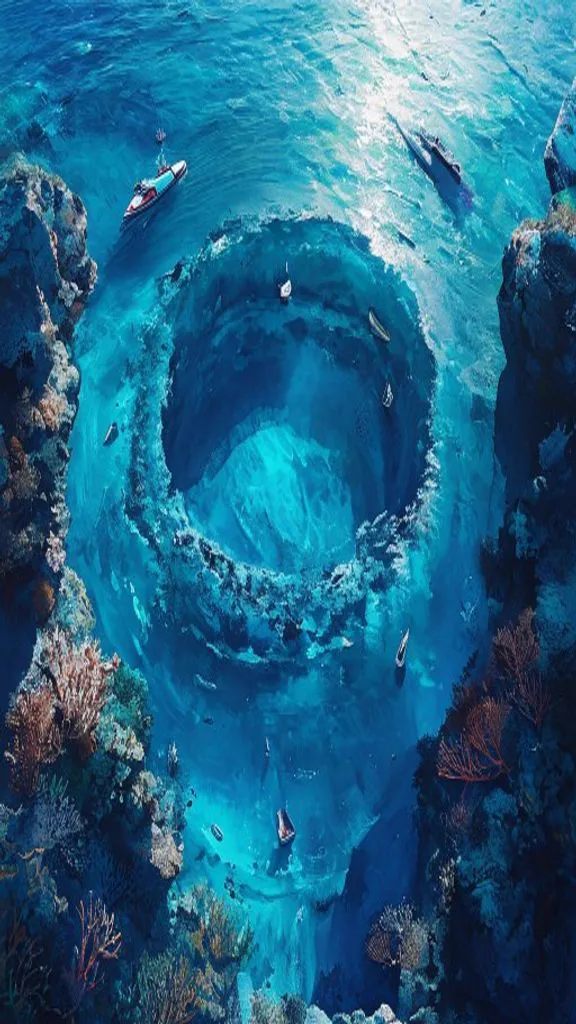
The boat cuts its engine and the sea changes character. Around the hull the water is the pale, sunlit turquoise of the Belizean shallows, barely five metres deep, the reef visible beneath the surface like a submerged garden. Then the bottom falls away. A ring of dark sapphire opens in the middle of the lagoon — a near-perfect circle, 318 metres across, dropping 124 metres into the seabed. From the deck it reads as a single, unblinking eye set in the face of the Caribbean. From a small plane banking overhead it is unmistakable: a dark pupil ringed by reef, one of the most recognisable natural shapes on Earth.
This is the Great Blue Hole, suspended in the lagoon of Lighthouse Reef, an atoll some 70 kilometres off the coast of Belize. It is not a crater and not a volcanic vent. It is a drowned cave — a limestone chamber that once stood in open air, with a roof and a floor and stalactites hanging in the dark, before the sea climbed up and swallowed it whole.
Jacques Cousteau brought the Calypso here in 1971 to chart its depths and ranked it among the ten finest dive sites in the world; the British diver Ned Middleton gave it its name in 1988. But the hole's deeper significance has nothing to do with dive ratings or symmetry. It lies in what the dark water keeps. Sealed off from light, oxygen and current, the bottom of the hole has been quietly recording the climate of the Caribbean for thousands of years — a time capsule filled not with objects but with mud, laid down one thin layer at a time.
To understand the hole, you have to drain the sea. Picture this stretch of the Caribbean not as water but as exposed land — a pale limestone plain baking under an Ice Age sky. For long stretches of the last few hundred thousand years, global temperatures ran far colder than today, vast ice sheets locked away enormous volumes of ocean water, and sea level stood far lower than its present mark. The shallow carbonate platforms off the Yucatán — banks of rock built up over millions of years by corals and algae — lay high and dry.
On that exposed limestone, water went to work. Rain, made faintly acidic by carbon dioxide in the air, soaked into every crack and seam, dissolving the rock grain by grain and hollowing out a hidden architecture below the surface: passages, galleries, vaulted chambers. Where water dripped from the ceiling over centuries it left mineral behind — stalactites reaching down, stalagmites building up, some thickening into columns. This is the ordinary, patient chemistry of caves, and it left a signature that survives underwater to this day.
That signature is how we know the hole's age. Stalactites can only grow in air, never underwater, so each one is a timestamp from a dry chapter in the cave's life. When scientists sampled and dated the formations inside the Blue Hole, they found not one age but several — growth during cold, low-sea phases roughly 153,000, 66,000, 60,000 and 15,000 years ago. The cave, in other words, was exposed and re-flooded more than once, breathing in and out with the long rhythm of the ice ages.
Then came the most recent thaw. As the last great glaciers retreated and their meltwater poured back into the oceans, the sea rose — slowly by human reckoning, relentlessly by geological. Water crept up the limestone walls, drowning the lowest passages first, then the galleries, then the great central chamber. At some point the unsupported roof of that chamber gave way and collapsed, leaving the open shaft we see now. The stalactites stopped growing the moment the water reached them, frozen mid-drip. What had been a dry, echoing cave became a flooded silence — its entrance swallowed, its history sealed beneath the new sea.
The first thing divers notice is the stillness. Down the vertical wall the light fades fast — visibility is excellent near the surface, but the brightness drops away below about forty metres, and the rim's small reef fish thin out and vanish. Past ninety metres the water turns anoxic: no oxygen, no light, no current to speak of. Larger sharks cruise the gloom where the reef life used to be. It is, by the standards of the open ocean, a dead zone — and that deadness is precisely what makes the hole valuable.
Because nothing stirs the bottom water, the finest sediment can settle there and stay settled, undisturbed, year after year. Over thousands of years this has built a sediment column at the floor of the hole that reads almost like the growth rings of a tree. The layers alternate in colour — grey-green to light green, depending on how much organic matter they hold — each pair marking a single year. It is one of the most undisturbed natural archives of its kind anywhere in the Caribbean.
People have been reading it for a quarter of a century. The geologist Eugene Shinn pulled the first long core from the hole's floor decades ago, recognising early that there was a record down there worth recovering. Then, in the summer of 2022, a team led by Goethe University Frankfurt floated a drilling platform out to the reef and extracted a single sediment core 30 metres long — a continuous slice running back through the entire Holocene and into the last Ice Age.
What they found in it was weather. Threaded through the calm grey-green layers were coarser, paler bands — beige to white, with larger grains — that stood out sharply from the rest. These are tempestites: the debris of storms, sand and shell flung in from the surrounding reef by hurricanes and washed down into the trap. Counting them, the researchers logged on the order of 574 storm events written into the mud over the past 5,700 years. The hole had not just survived those storms; it had been quietly cataloguing them, one violent afternoon at a time, long before anyone else was keeping records.
This is what changes how you see the place. The Blue Hole is not only a wonder to be looked at. It is a document to be read.
Most people meet the Blue Hole from above. Day boats run out from San Pedro and the cayes; light planes trace lazy circuits so passengers can photograph the dark circle whole. The story they hear is the famous one — Cousteau, the Calypso, the perfect ring, the top-ten dive. It is a story about spectacle, and the spectacle is real. But it can flatten the hole into a postcard, a fixed and finished thing, when the truth is that it is still recording, still responding to the world around it right now.
Read the recent layers of that sediment core and the message turns uneasy. The same archive that logged storms across nearly six millennia shows the pace of those storms quickening in the most recent decades — more tempestites, packed more closely, than the long-run average would predict. The researchers who drilled the core tie this to a warming climate and warmer seas, the conditions that let tropical storms form more often and intensify faster. Their record, they note, is the longest continuous, year-by-year account of tropical cyclone activity yet recovered, and what it implies for the century ahead is not reassuring: more storms, not fewer.
Human time has reached the bottom, too. When submersibles mapped the interior in detail in 2018 — a mission that put Fabien Cousteau, grandson of Jacques, and Richard Branson into the deep in two-person subs — they brought back a fine 3D portrait of the walls and the ancient sediment, and something less welcome: plastic, settled on the floor of one of the most isolated places in the Caribbean, more than a hundred metres down. The waste of the surface world had found its way into a chamber the sun cannot reach.
The hole sits inside the Belize Barrier Reef Reserve System, protected and listed by UNESCO, and that protection matters. But protection cannot wall it off from the climate. The Blue Hole was made by a planet warming and seas rising once before, at the close of the last Ice Age. It is now watching the same forces return — faster this time, and largely of our making. It does not warn or plead. It simply keeps its layers, and lets us read what we are doing in them.
At Antropeo we never lowered a hydrophone into the Blue Hole or shipped a drill barge out to Lighthouse Reef, and we are not going to pretend we did. The science here belongs to the divers, geologists and core-drillers who spent years recovering it. The most honest thing we can do is point you toward their work and get the facts right.
What we do is smaller, and we think it is worth doing. We take real places like this one and turn them into something you actually meet — a question, an image, a few seconds of attention in the middle of a game — rather than a line to be memorised and forgotten. The Great Blue Hole earns its place in Antropeo precisely because it needs no embellishment. A limestone cave that stood in open air through four Ice Ages, drowned by the rising sea, now lying in the dark and quietly counting the storms we are making worse: that is the real story, and it is stranger and better than anything we could invent.
So the next time the hole surfaces in a round — a dark circle in a turquoise sea — you will know what you are looking at. Not a crater. Not a void. A memory, kept in stone and mud, of how fast a world can change.
Earth
In 1911 an American professor was led up the mountain by a local man. The families who lived there already knew the place.
Earth
In 1883 a volcano in Indonesia blew up. The bang crossed the Indian Ocean, and the pressure wave went around the world.
Earth
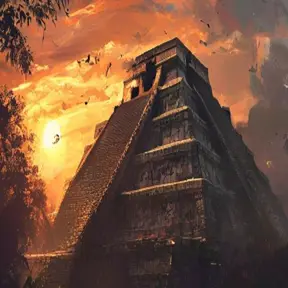
A Maya pyramid in Mexico seems to hold a snake made of shadow and a bird made of echoes. Nobody knows whether that was planned.
Earth
In 1991 a man in Vietnam found a cave by its sound. It has its own river, its own weather and its own jungle.