The Aymara Paradox: How an Ancient Andean Civilisation Reimagines Time, Space, and Survival
For over 2,000 years, the Aymara people have thrived in the extreme Andes by seeing geography not as territory to conquer, but as living kin. Their backward-looking language, sacred mountains, and ancient agricultural systems offer urgent lessons for a warming planet
Aymara is more than a point on a map. It is a geography story about people, places, movement, and the systems that shape daily life.
Sacred Geography: How the Aymara See Time, Space, and Nature
-The Living Landscape
High in the Andes, where the air is thin and the mountains pierce the sky, the Aymara people have lived for over two thousand years. Their homeland spans the rugged altiplano—a vast high plateau stretching across western Bolivia, southern Peru, and northern Chile. At elevations exceeding 3,800 metres (12,500 feet), this is one of the most extreme inhabited environments on Earth.
Yet the Aymara did not merely survive here; they thrived. They developed sophisticated agricultural terraces that transformed steep mountainsides into productive farmland. They domesticated llamas and alpacas, animals uniquely adapted to high-altitude life. They built cities like Tiwanaku, which became one of the most powerful pre-Columbian empires in South America.
Central to Aymara survival was—and remains—a profound understanding of their environment. But unlike Western geography, which treats land as a resource to be mapped and exploited, the Aymara worldview sees geography as alive, sentient, and sacred. Mountains are not geological formations; they are *achachilas*, protective spirits. The Earth is not a planet; she is *Pachamama*, a living mother who must be honoured and fed.
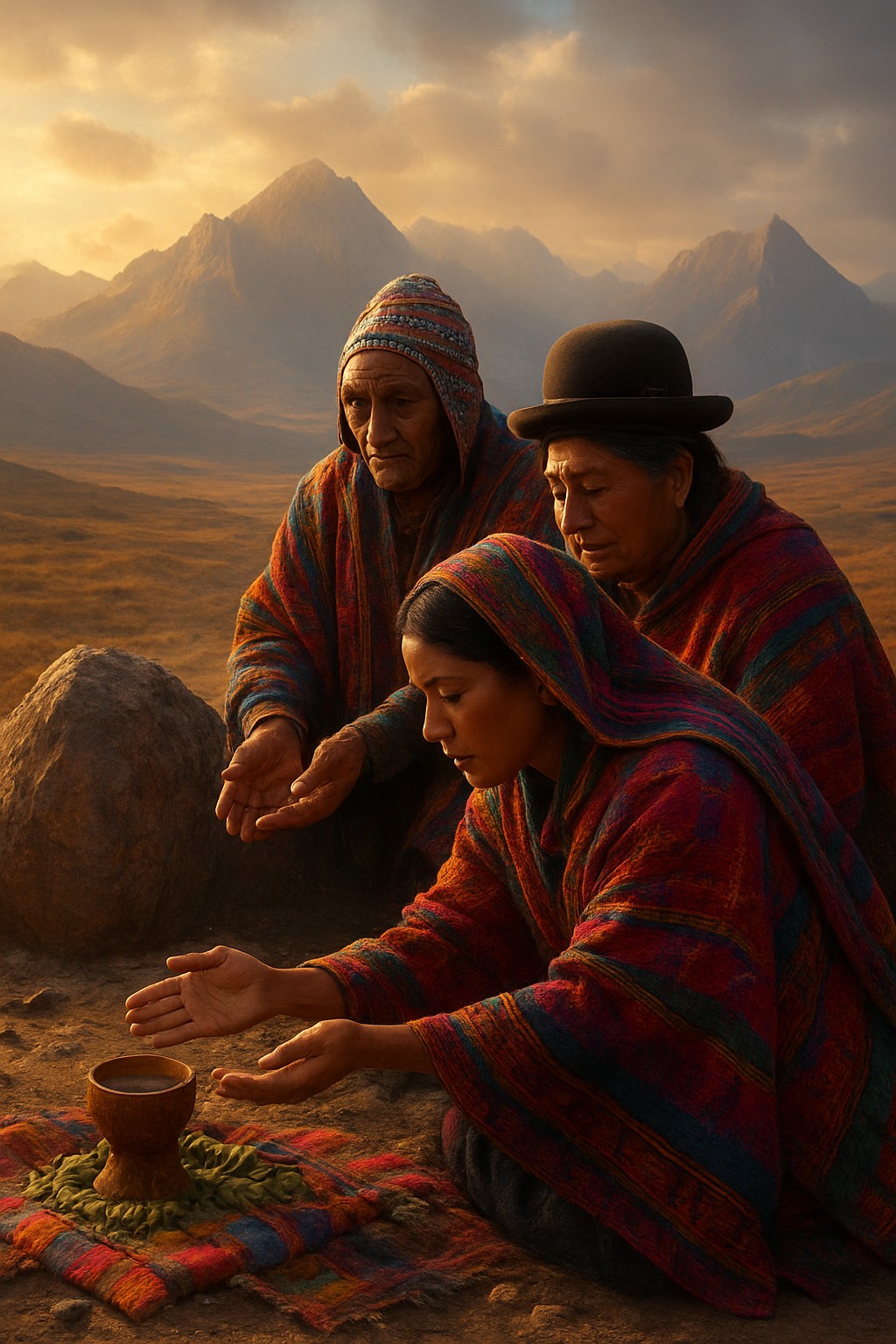
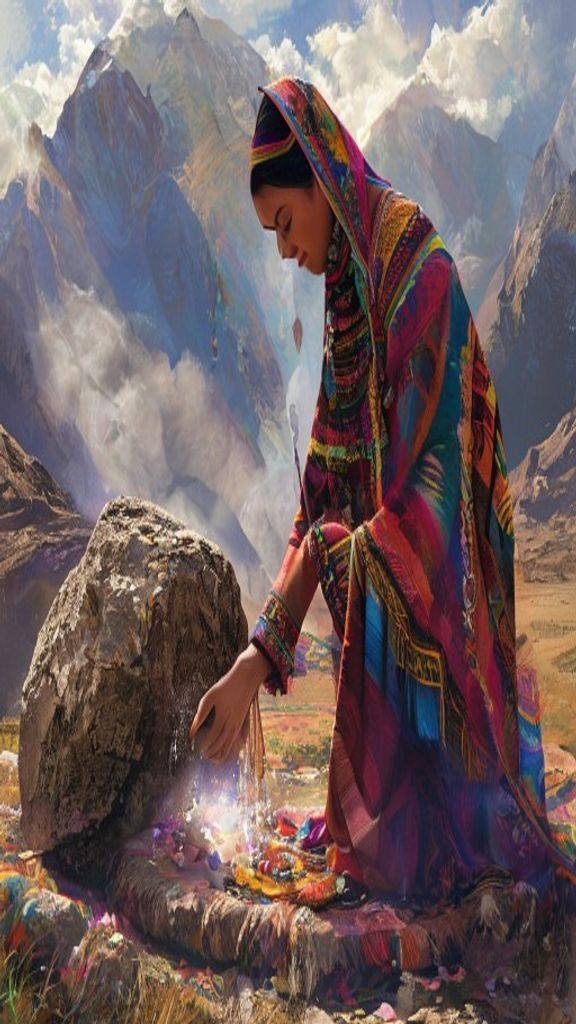
This is where the image you see becomes more than a photograph. It shows an Aymara woman making a *ch'alla*—a ritual offering to Pachamama. The colourful textiles, the coca leaves, the ceremonial alcohol: these are not superstition. They are expressions of a geographical philosophy that recognises human dependence on the natural world.
-The Backward-Looking Language
Here is where Aymara geography becomes truly extraordinary: their language fundamentally reverses how most humans conceptualise time and space.
In Spanish, English, and most Indo-European languages, we face the future. We speak of "looking ahead" to what's coming. The past is "behind us." This spatial metaphor is so embedded in our thinking that we rarely question it.
The Aymara do the opposite. In their language, the word for "front" (*nayra*) also means "past." The word for "back" (*qhipa*) means "future." When Aymara speakers talk about yesterday, they gesture forward. When they speak of tomorrow, they gesture behind them.
This is not a quirk of translation. It reflects a fundamentally different way of understanding existence. For the Aymara, the past is what you can see—you know it, you've witnessed it, it's visible before your eyes. The future is unknown, unseen, literally behind you where you cannot look.
Linguists and cognitive scientists have studied this phenomenon extensively. Research by Dr. Rafael Núñez at the University of California, San Diego, and Dr. Eve Sweetser at UC Berkeley, documented this temporal-spatial reversal in the early 2000s. Their work showed that language doesn't just describe reality; it shapes how we perceive it.
When you view the past as "in front," you walk forward carrying your history with you. You don't "leave the past behind"; you bring it into every step. For the Aymara, ancestral knowledge, traditional practices, and historical memory are not relics to be discarded in the march toward progress. They are the visible landscape through which you navigate.
-Mountains as Ancestors, Water as Life
For the Aymara, geography is not neutral territory. Every mountain, river, and valley possesses agency, consciousness, and spiritual power. This is not abstract philosophy; it is a practical framework for survival that has guided Aymara communities for centuries.
The *achachilas*—the mountain spirits—are perhaps the most powerful beings in Aymara cosmology. These are not distant gods but active participants in daily life. Mount Illimani, which dominates the skyline above La Paz, is not simply a 6,438-metre peak. It is a protective ancestor, a guardian who watches over the city and its people. When Aymara farmers look to the mountains, they are not admiring scenery; they are consulting oracles. The patterns of snow, the movement of clouds, the behaviour of wildlife on the slopes: all are read as messages from the achachilas about weather, harvests, and community welfare.
Water, too, is alive. The Aymara do not speak of "water resources" but of *uma*, a living entity that flows through the landscape with its own intentions and needs. Springs are not hydrological features but sacred sites where the Earth's vitality emerges. Rivers are not channels for irrigation but veins of Pachamama, carrying her lifeblood through the land.
Dr. Marisol de la Cadena, an anthropologist at the University of California, Davis, has spent decades documenting these indigenous ontologies. In her groundbreaking work, she argues that the Aymara do not simply have "beliefs" about nature; they inhabit a world where nature *is* personhood. Mountains, water, and Earth are not objects with symbolic meaning added by humans. They are subjects with their own perspectives, intentions, and rights.
Ancient Wisdom, Modern Cities: Aymara Geography Today
-From Tiwanaku to La Paz
The Aymara are not a historical footnote. Today, over two million Aymara people live primarily in Bolivia, Peru, and Chile, with significant diaspora communities in Argentina and beyond. They are one of the largest indigenous groups in South America, and their geographical influence shapes the region in ways both visible and invisible.
Consider La Paz, Bolivia's administrative capital and one of the highest major cities on Earth. Built in a bowl-shaped canyon surrounded by towering peaks, La Paz sits at approximately 3,650 metres (11,975 feet) above sea level. The city's very existence is a testament to Aymara geographical knowledge.
But La Paz also reveals the tensions between indigenous and colonial geographies. Spanish colonisers arrived in the 16th century and imposed their own spatial order—grid patterns, central plazas, churches built atop indigenous sacred sites. Yet the Aymara persisted. Today, the city's markets, its neighbourhoods, its very rhythm of life remain deeply influenced by Aymara culture.
The cholitas—the Aymara women recognised by their distinctive bowler hats, colourful pollera skirts, and braided hair—have become symbols of indigenous resilience. Once marginalised and discriminated against, they are now entrepreneurs, politicians, and cultural ambassadors. In 2005, Bolivia elected Evo Morales, an Aymara coca farmer, as its first indigenous president. His election marked a geographical and political renaissance for the Aymara people.
-Engineering the Andes: Agricultural Mastery
The Aymara did not simply adapt to their environment; they transformed it through sophisticated geographical engineering. Their agricultural systems remain some of the most impressive examples of human adaptation to extreme environments anywhere on Earth.
Terracing is perhaps the most visible legacy. Across the Andean slopes, Aymara farmers carved thousands of kilometres of agricultural terraces, called *andenes*. These are not simple flat surfaces cut into hillsides. They are complex systems designed to maximise arable land, prevent erosion, manage water distribution, and create microclimates. The stone retaining walls absorb heat during the day and release it at night, protecting crops from frost. The terraces can reduce soil erosion by up to 90% compared to conventional hillside farming.
Even more remarkable are the *waru waru*—raised field systems that date back over 3,000 years to the Tiwanaku civilisation. These are elevated planting platforms surrounded by water channels. The water absorbs solar heat during the day and releases it at night, creating a protective microclimate that can raise temperatures around crops by up to 3°C. This seemingly simple innovation allows farming at altitudes and in conditions that should be impossible.
Dr. Clark Erickson, an archaeologist at the University of Pennsylvania, has studied these systems extensively. His research shows that waru waru can produce yields three to four times higher than conventional modern farming in the same region—without fertilisers, pesticides, or irrigation pumps.
When Spanish colonisers arrived, they dismissed these systems as primitive. Many fell into disuse. But in recent decades, as climate change makes modern industrial farming increasingly vulnerable, Aymara communities and development organisations have begun reviving these ancient techniques. In Bolivia and Peru, thousands of hectares of waru waru have been restored, proving that geographical knowledge from two millennia ago remains more relevant than ever.
-Climate Crisis and Sacred Mountains
Yet challenges remain. Climate change is hitting the Andes hard. Glaciers that have fed Aymara communities for millennia are disappearing. The Illimani glacier, which towers over La Paz and features prominently in Aymara cosmology, has lost nearly half its mass since the 1940s.
For the Aymara, this is not just an environmental crisis; it is a spiritual catastrophe. When a glacier disappears, an achachila dies. The protective ancestor vanishes. Water sources that have sustained communities for generations run dry. The geographical and the spiritual collapse together.
Mining operations threaten sacred mountains. Urban expansion encroaches on traditional agricultural lands. The tension between development and preservation plays out daily in Aymara communities.
But the Aymara continue to assert their geographical sovereignty. They maintain their language—Aymara is an official language in Bolivia and Peru. They practice their rituals, like the ch'alla offerings to Pachamama. They farm using traditional methods adapted for modern challenges.
What the Aymara Teach Us About Belonging to Place
Suma Qamaña: Living Well, Not Living More
Increasingly, the wider world is recognizing that Aymara geographical knowledge offers solutions to contemporary problems. Indigenous land management practices are being studied for their potential to combat climate change. Traditional water conservation techniques are being revived. The Aymara concept of *suma qamaña*—living well, in harmony with community and nature—is being adopted as an alternative to Western models of endless economic growth.
Suma qamaña (also known as *vivir bien* in Spanish) is not about individual prosperity or material accumulation. It is about collective wellbeing, balance with the natural world, and maintaining harmony between past, present, and future. In 2009, Bolivia became the first country to incorporate suma qamaña into its constitution, recognizing the Rights of Mother Earth and establishing legal frameworks that prioritize ecological balance over unlimited growth.
This philosophy stands in stark contrast to Western development models. Where capitalism measures success through GDP growth, suma qamaña asks: Are our communities healthy? Is the land productive? Are the mountains still standing? Is the water clean? Are we honouring our ancestors while protecting the future?
These are not abstract questions. They are geographical metrics—ways of measuring whether a place is truly thriving.
-Lessons for a Warming World
What can the Aymara teach the rest of us about geography and survival in the twenty-first century?
First, that time is not linear progress but a circle we walk within. The past is not behind us; it is before us, visible and instructive. Traditional knowledge is not outdated; it is time-tested. When facing unprecedented climate change, the Aymara remind us that looking backward—studying how communities survived previous environmental shifts—may be the best way forward.
Second, that nature is not a resource but a relationship. The Aymara do not "manage" mountains or "exploit" water. They maintain reciprocal relationships with living beings. This is not romanticism; it is practical geography. Communities that view mountains as ancestors protect them more effectively than those that view them as mineral deposits. Societies that see water as a living entity conserve it more carefully than those that see it as an H₂O resource.
Third, that extreme environments demand extreme respect. The Aymara have survived for two millennia in one of Earth's harshest inhabited regions not by conquering nature but by understanding it intimately, adapting to it flexibly, and honouring it constantly. As climate change makes more regions "extreme"—through drought, flooding, heat, or cold—the Aymara example becomes increasingly relevant.
Dr. Arturo Escobar, a Colombian anthropologist who has studied Latin American indigenous movements, argues that the Aymara worldview represents not a return to the past but a pathway to alternative futures. "The Aymara are not trying to preserve a static tradition," Escobar notes. "They are demonstrating that modernity itself can be plural—that there are multiple ways to be modern, multiple ways to organize geography, economy, and society."
-The Future of Indigenous Geography
The Aymara are not asking to be left alone in remote mountain villages. They are demanding recognition as equal participants in shaping the future of their regions and their planet. They are using modern tools—GPS mapping, satellite imagery, legal frameworks, social media—to defend traditional knowledge and territorial rights.
Young Aymara activists are creating digital archives of oral histories. Aymara scholars are publishing academic research that bridges indigenous and Western knowledge systems. Aymara politicians are implementing policies based on suma qamaña principles. Aymara farmers are combining ancestral agricultural techniques with climate science to develop resilient food systems.
This is not resistance; it is innovation. The Aymara are demonstrating that indigenous geography is not a museum exhibit but a living, evolving practice capable of addressing contemporary challenges.
As the world faces climate crisis, biodiversity collapse, and growing inequality, the Aymara offer more than cultural diversity. They offer geographical diversity—different ways of understanding space, time, nature, and human purpose. They remind us that the maps we carry in our heads shape the world we create on the ground.
In the end, the Aymara teach us that geography is not just about knowing where places are. It is about understanding how to belong to them—how to live in right relationship with mountains, water, land, community, ancestors, and future generations. It is about recognizing that we do not inhabit a dead planet of resources waiting to be used, but a living world of subjects with whom we must negotiate, cooperate, and coexist.
For over two thousand years, the Aymara have practiced this geography of belonging in one of Earth's most challenging environments. As the twenty-first century unfolds, their wisdom may prove essential not just for their own survival, but for ours as well.
What this teaches us about geography
The Aymara are more than a point on a map. They are a civilisation that has thrived for over two millennia in one of Earth's most extreme environments—the Andean altiplano, where oxygen is scarce, temperatures swing wildly, and the land itself seems to touch the sky. Their geography is not just about location; it is about people, places, movement, sacred landscapes, and the systems that shape daily life in ways that challenge everything modern society thinks it knows about time, space, and our relationship with the natural world.
In an age of climate crisis, when Western models of development and environmental management are increasingly questioned, the Aymara offer something invaluable: a different way of seeing. For them, mountains are not geological formations but living ancestors. The Earth is not a resource but a mother. The past is not behind but before you, visible and guiding. This is not poetry or metaphor; it is a sophisticated geographical philosophy that has sustained communities in one of the planet's harshest inhabited regions for over two thousand years.
Today, more than two million Aymara people live across Bolivia, Peru, Chile, and Argentina. They speak their language, farm their ancestral lands, make offerings to Pachamama, and navigate a world that often marginalises indigenous knowledge. Yet their influence extends far beyond their communities. As glaciers disappear and ecosystems collapse, scientists, policymakers, and geographers are increasingly turning to Aymara wisdom for solutions. What can a pre-Columbian civilisation teach us about surviving the twenty-first century? The answer lies in understanding that geography is not just about where we are—it is about how we belong.